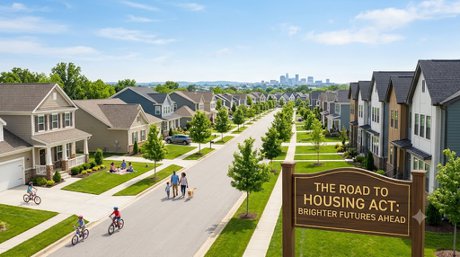
A massive shift has officially hit the real estate market. On July 11, 2026, the 21st Century ROAD to Housing Act officially became federal law. In a rare political move, the bill became law without President Trump’s signature after overwhelmingly passing both the House and Senate with broad bipartisan majorities.
This isn't just another minor tweak to the tax code. This is the most significant federal housing legislation passed in over 30 years.
If you are a hopeful homebuyer, a homeowner, or someone simply trying to navigate today’s wild housing market, here is a plain-English breakdown of what this massive new law means for you.
1. Leveling the Playing Field: Limits on Wall Street Buyers
If you have tried to buy a home recently, you know the frustration of competing against deep-pocketed corporate buyers who make quick, all-cash offers. The ROAD to Housing Act tackles this head-on with a groundbreaking provision called "Homes are for People, Not Corporations".
National Low Income Housing Coalition
- The Rule: "Large institutional investors"—defined as any for-profit company that owns or manages 350 or more single-family homes—are now prohibited from buying additional single-family homes. This restriction takes effect 180 days after enactment.
- The Penalty: If a mega-corporation violates this law, they face steep civil penalties of up to $1 million or three times the purchase price of the home (whichever is greater).
- The Exception: Developers can still build "Build-to-Rent" (BTR) communities. The final version of the law allows corporate builders to build whole new neighborhoods specifically intended as rentals, recognizing that we still need a steady supply of high-quality rental housing.
What this means for you: This should significantly cool down corporate competition for "starter homes," leaving more inventory on the market for everyday families and first-time buyers.
2. Breaking the Supply Bottleneck: Building Homes Faster
The root cause of high home prices is simple: we do not have enough houses. The U.S. is currently short by an estimated 5.5 million housing units. The ROAD to Housing Act aims to fix this by cutting local bureaucratic red tape and offering big financial carrots to cities that build.
- Cash for Cutting Red Tape: The law establishes a $200 million annual competitive grant program (the Innovation Fund) for local and tribal governments. To get this money, local governments must prove they are increasing housing supply by streamlining their permitting process, offering density bonuses, or adopting smarter zoning laws.
- Pre-Approved Blueprints: Local governments can use grant money to adopt pre-reviewed, ready-to-use home designs for accessory dwelling units (ADUs), duplexes, and townhouses. This means builders can skip months of waiting for architectural approvals and get straight to work.
- Lowering Construction Costs: The law removes outdated federal regulations on manufactured and modular homes. For example, by removing the requirement that manufactured homes must be built on a permanent metal chassis, the law is expected to shave about $3,000 off the cost of building a manufactured home.
3. Cutting Red Tape and Helping Communities
To make housing affordable, the government also had to look at its own regulatory hurdles. The new law streamlines federal processes to make building and financing cheaper and faster.
Smarter Environmental Reviews: Under the National Environmental Policy Act (NEPA), even minor housing projects used to face long, expensive environmental reviews. The new law creates "categorical exclusions" for infill housing, home rehabilitations, and new construction projects of 15 units or fewer. Less time in administrative limbo means lower costs for developers—which translates to lower prices for buyers.
- Reforming the HOME Program: The law modernizes the federal HOME program—the largest federal block grant used by states to build affordable housing. It expands income limits up to 100% of the Area Median Income (AMI) and gives local jurisdictions much greater flexibility to use these funds for vital neighborhood infrastructure.
The Quick Takeaway: How the Market is Changing
|
Feature |
The Old Way |
The New Way (Under the ROAD Act) |
|
Institutional Investors |
Wall Street giants could buy up entire blocks of single-family starter homes. |
Companies with 350+ homes are blocked from buying single-family homes. |
|
Local Permits & Zoning |
Months (or years) of administrative delays and strict zoning rules. |
Fast-tracked permitting and pre-approved designs for ADUs, duplexes, and townhomes. |
|
Manufactured Housing |
Rigid definitions kept factory-built housing expensive to construct and finance. |
Modernized standards that make high-quality, factory-built homes cheaper to build and buy. |
The Bottom Line
Change won't happen overnight. Many of these provisions will roll out over the next few years as federal agencies like HUD write the official guidelines. However, this law represents a major structural shift in the American housing market. By encouraging local construction, removing federal red tape, and sidelining mega-investors, the ROAD to Housing Act is designed to make the dream of homeownership accessible to millions of everyday Americans once again.
We will keep a close eye on how this impacts our local market and inventory. If you have questions about how these changes might affect your plans to buy or sell, let's chat!


